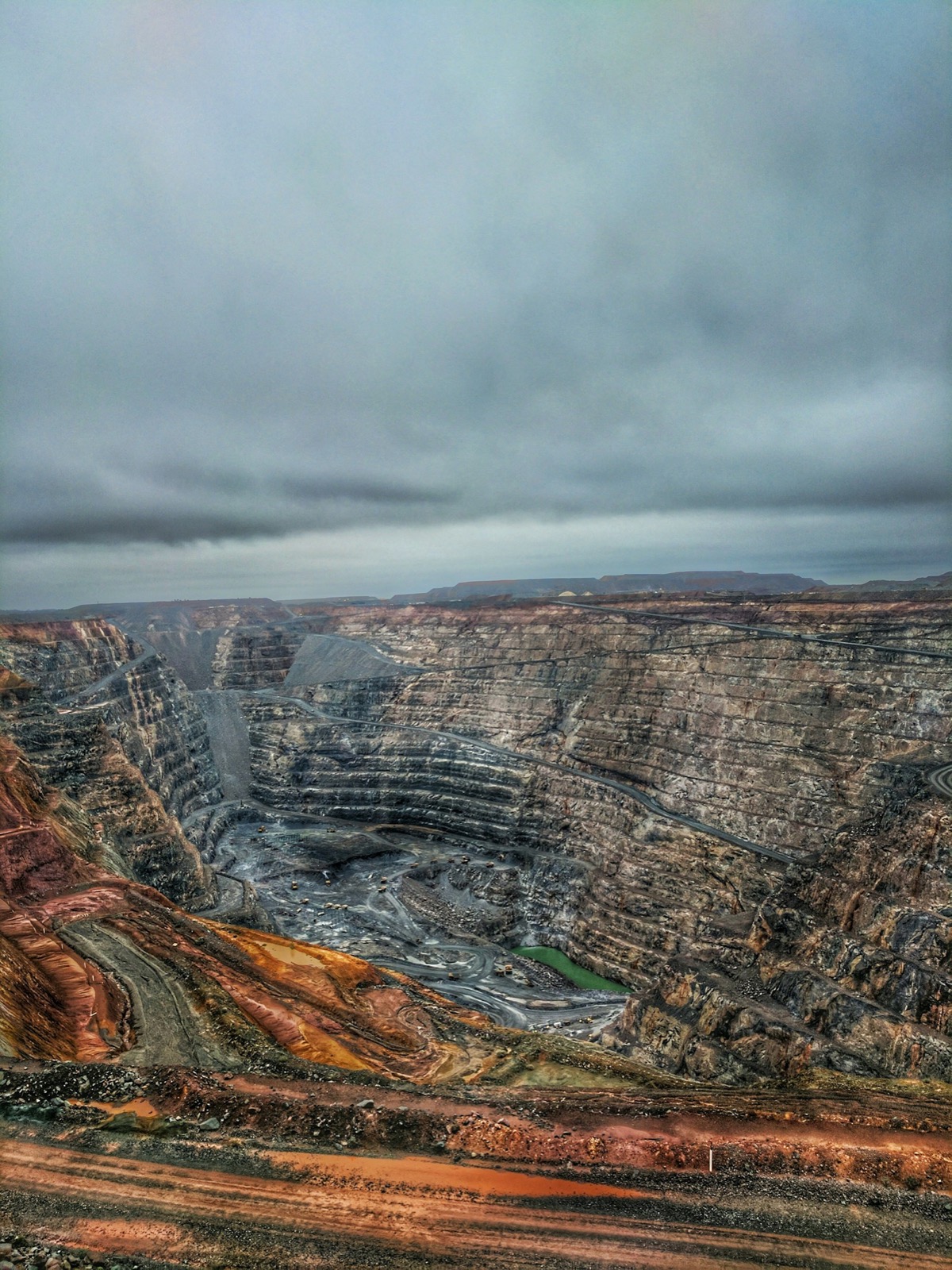
Haul-road corrugation quietly destroys haul-truck tires. A single tire set costs $60,000–$120,000. Corrugation lifts wear 20 to 40% and forces earlier replacement. Continuous IMU-derived corrugation intensity lets sites move grading from a calendar schedule to a condition trigger, usually cutting grading passes 25 to 40% while improving the tire-cost metric.
Haul roads are not usually the first item on the mine operations agenda. They should be. On an open-pit operation running a Tier-1 haul fleet of 25 to 60 trucks, the haul-road surface state drives three of the top ten operating cost lines: tire wear, fuel burn, and suspension maintenance. Each of those moves by double-digit percentages with the surface condition, and the surface condition is driven almost entirely by corrugation.
What corrugation actually is
Corrugation is the periodic washboarding that forms on unsealed haul roads under repeated loaded-truck traffic. It starts as a subtle, sub-centimetre amplitude wave pattern at around 0.5 to 1 m wavelength. On a new ramp, it is invisible. Two weeks later, it is a millimetre deeper and the drivers start feeling it. A month later, the grader operator looks at it, decides it is time, and a grading pass is scheduled.
The cost damage has already happened by then. Corrugation at even low amplitudes accelerates tire wear through continuous sidewall flex and increased rolling resistance. The rule of thumb in Pilbara iron-ore operations is that every two weeks of un-graded corrugation translates to 1 to 2% of tire life lost across the fleet. On a 30-truck operation running $90,000 tire sets on a 9,000-hour rotation, that is roughly $500,000 per year of tire cost that never appears in the haul-road operating-cost code.
Why visual inspection misses it
Visual inspection catches corrugation once it is photogenic. The eye picks up a washboard when the amplitude crosses about 5 to 8 mm, at which point the grader operator's opinion and the tire-wear data are in rough agreement. Three problems with that:
- It is late. The tire-wear cost has been accumulating for a fortnight by the time anyone sees it.
- It is subjective. Different operators flag different segments as "needing a grade." Grading schedules become negotiation artefacts rather than engineering ones.
- It doesn't prioritise. Visual inspection tells you where corrugation exists, not which section is costing the most. A 300 m stretch of high-amplitude corrugation on the loaded ramp is not equivalent to a 1 km stretch of low-amplitude corrugation on the return haul.
IMU-derived corrugation measurement
A smartphone IMU sampling at 25 Hz on a light vehicle or a haul truck produces a vertical-acceleration trace. Corrugation appears in that trace as a characteristic frequency band, typically 3 to 8 Hz at haulage speeds, with amplitude scaling linearly with washboard depth.
Run that analysis continuously across a haul-road network and three things fall out:
- Onset detection. The corrugation frequency band starts rising well before the washboard is visually obvious. Sites that act on onset detection grade 10 to 14 days earlier than sites that wait for visual confirmation.
- Segment-level intensity. Every stretch of haul road gets a corrugation-intensity score updated continuously. The grading order is ranked automatically.
- Tire-cost attribution. Because every truck pass produces a telemetry record, operational accounting can finally assign tire wear to specific haul-road segments.
Moving from calendar to condition
The typical open-pit operation runs a fixed grading schedule: every 7 or 14 days, every segment, rain or shine. It is a compromise between tire cost (grade more often) and grader-operating cost (grade less often). Because the compromise is fixed and uniform, half the segments are over-graded and the other half are under-graded.
Sites that move to a condition-based schedule typically report:
- 25 to 40% fewer grading passes overall. Grading now happens where it is needed, when it is needed.
- 5 to 15% improvement in measurable tire life across the fleet.
- 10 to 25% reduction in grader fuel and wear-parts consumption, because graders run less often but under higher-value conditions.
- A defensible operating-cost narrative for the mine, because every grading pass is traced back to a corrugation-intensity threshold crossing and a named segment.
The economic case is usually obvious inside the first quarter. The harder win is the management-reporting change. Mine ops meetings that used to argue about grading frequency now argue about corrugation thresholds, and that is a much more productive conversation.
The dust-chemistry connection
Sites that run dust-suppression chemistry on haul roads (polymer binders, chloride blends, specialty binders) have a complementary reason to care about continuous corrugation data. Corrugation is partly a function of the binder state. A fresh, well-cured surface corrugates 40 to 60% slower than an aged one. Seeing corrugation intensity rise sharply on a treated segment is an early-warning signal that the binder is failing and a re-dose is due.
Sites that combine continuous condition data with their suppression program typically integrate both into a single haul-road operating dashboard. The grading schedule, the dosing schedule and the water-truck schedule all get driven from the same condition evidence, rather than from three separate traditions of calendar-based planning.